

Maybe a Robot Will Solve Global Warming
(or, Asking for Favors in the Technodystopia) By MARE

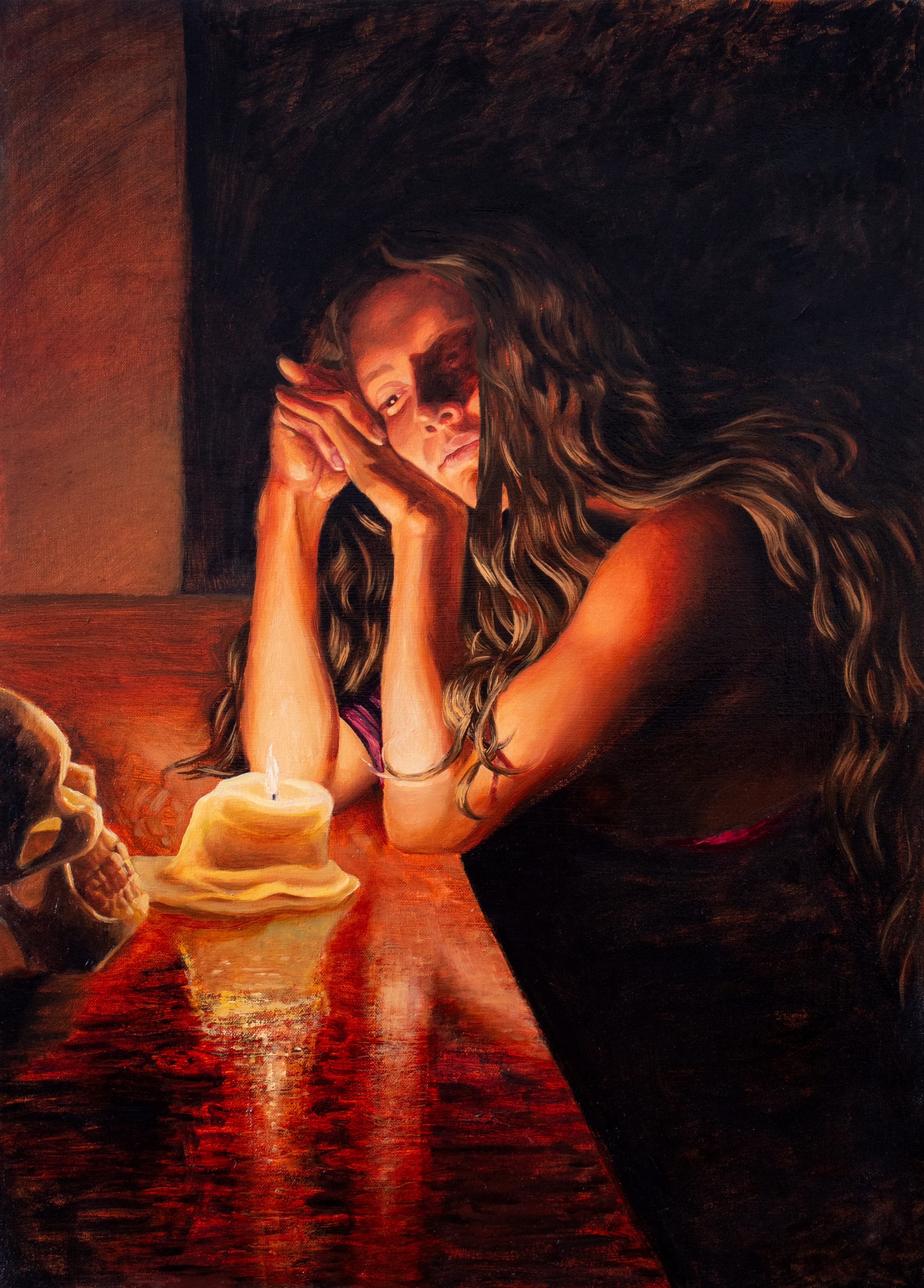
This work is offered to all those impacted by wildfires and to the spirit of the flame itself.
They’re saying AI will solve all these problems. They’re saying it can cure diseases. Maybe a robot will cure cancer. We will see if its problem-solving abilities are so fine that it can save the world it was built to make richer. If that’s true, then yes, maybe it can cure cancer too.
I google, “is AI bad for the environment.” The first thing I see is a summary made for me by an AI bot. The chicken is answering the adage and telling me that every time an egg is laid the coop is closer to being unsustainable for all chicken life. It tells me “AI requires a lot of energy, which is often generated by burning fossil fuels, a major contributor to global warming. The International Energy Agency estimates that by 2026, AI, cryptocurrency, and data centers could use 4% of the world’s annual energy.” The world is burning, and we are starting fires. We have created a whole fake world, and in that world the Sims are on fire. We stray further from the tangible and dip our hands into imaginary pools of fake money bathed in real blood and wash our hands with whatever truth the robot hands us.
In my mindless, stumbling, meandering scrolling, I stop and stare at an infographic with an ex machina apparition of a silver robot hand to visualize that every hundred-word AI-written email is the equivalent of pouring out a water bottle. Artificial intelligence doesn’t have hands, but I imagine the cold metal hand pouring bottle after bottle after bottle of water into dust bowl plain dry land while a Dorthea Lange mother weeps tears of Poland Spring, Fiji, or very Smart Water. I imagine robot hands even though what we call AI has never had hands, meaning AI has never gotten a paper cut and forgotten until it’s washing dishes or had its pinky held in the entire hand of a baby or gripped a barbell and pulled hard in a test of strength. No, none of that because AI lacks hands. It has never experienced having hands.
I have learned when I fire up the search engine to add “minus AI” to each prompt. Technological advancements are developed and unleashed upon the public by those who will never face the consequences of these choices. AI is answering questions we never asked, having transformed in an instant from mere hypothetical to an omnipresent virus some tech titan in a sweatshirt says we have to opt out of like asking for no ketchup on a burger. Hold the sauce, no artificial intelligence. Please.
A literal translation of reincarnation is “to become meat again.” The fleshy lack of robots excuses them from the karmic wheel and cycle of birth, life, death, afterlife. I’ve learned it’s a mystery how we got here, but a creationist will tell you we were all intelligently designed. This AI has intelligence in its name, but we don’t know yet how that compares to the intelligence of humanity, or a tree, or a mushroom, or capital-i Intelligence, if you like to call your God that. I remember a podcast that discussed how quick we were to accept the title “artificial intelligence” and how quickly we abbreviated it to separate the creation from its name. There’s a joke about Frankenstein vs. his monster in there, but I won’t make it. Instead I will tell you that I played a robotic future robobride of Frankenstein in a college theater production where my power pack was ripped from my back mid–dream ballet, and I had to mime an improvisational dance to gesture that I was short-circuiting and dying. Perhaps I have more empathy for its experience than I remember, but I know a robot has never played me on a stage or thought about how I would die as it put itself into costume and painted its face white.
The bot doesn’t say “I require a lot of energy.” The bot doesn’t say “I’m tired.” The bot doesn’t say “I have CPTSD.” The bot doesn’t say it’s hot or thirsty as its servers are showered in water to keep it from overheating. The bot doesn’t say “I failed.” The bot has never said “I” at all. It feels like “I” is all I say. I don’t know if the AI will say “I live on earth too.” I don’t know if it will solve global warming. I don’t know if it will save this planet because it calls it home. I don’t know if it will just starve, dehydrate, and burn with us. I don’t know if it will save this planet because a scientist asked it to. I hope the scientist asks nicely.
Sometimes I have used AI. I had it proofread the job applications I shot into the void. I asked it to help with difficult conversations with friends. I’ve had it help me craft a blunt, therapy-speak, but somehow still kind of bitchy text to people I thought were friends. The bot asks me if I remember when I looked up Adult Children of Alcoholics and Dysfunctional families. I do.
This is when I admit that I have been smoking and vaping too much. Burning and blackening my lungs, even if only a little bit, because I don’t think I’ll live to the age when lung cancer will be a problem because I can’t help but think the earth has thirty good years left, which means I’m halfway to our shared death. At this moment I think maybe artificial intelligence can cure my lung cancer—or more likely my emphysema because that is what killed my father’s mother. She didn’t have a robot to cure her diseases, and I don’t think she thought about how many years she had until our planet would be too hot for us all to live here without fighting for sustenance that was plentiful before this country had an ugly English name. Start your engines: the race is on between a robot curing lung cancer, a robot saving our planet from climate change, and my death date, whenever that may be. We will see if its problem-solving abilities are so fine that it can save the world it was built to make richer.
Maybe we all crave the flame. We’re meant to gather around the fire. We always have. There was a time when the only sign of human life was a campfire in the distance. Maybe we will reach a time like that again. And maybe around that nonceremonial flame we will recount how we smoked, and grilled, and vaped, and heated our homes with coal, and lit a tree on fire to ask a robot where our commas go because we can’t always remember, and how our candles were scented because we always always always wanted to light things on fire, but normally you needed a really good reason. We couldn’t look at a book and not burn it. We couldn’t look at the kindling and the matches and just leave it. We simply couldn’t.
I fail, sometimes I feel like I fail every day. I put my sandwich in the plastic bag; I order a flower crown from a company named after the rainforest we’re destroying; I tell the bot that it doesn’t feel good to make a futile attempt at fixing another friendship so it can reassure me and wish me well even though it has not experienced friendship or thirst or birth. I cannot resist the plastic, the synthetic synthesis. My pen dies and I will throw it out and steal another one from a restaurant or my gym or a work conference. But maybe it’s worth it because maybe I’ll finally check everything off my to-do list or maybe I’ll finally write a good poem. My high horse has bolted. I was going to say I will fight for this planet until my dying breath, but maybe it’s like when we tell our family we would kill for them, that we would die for them. Probably not. Maybe we should just say we will try our best.
Last week I went to the lily pond where I sit and meditate. I go there at least once a week, more when I’m stressed. I tell the pond that I hope my presence and practice there makes it a little more sacred every time. I greet the land by name because one time my teacher told me that the land likes to be greeted by name. I take out my headphones after touching a tree trunk. A heron lands in the water. We perch together, two occasional visitors to the pond. I hear a girl ask her mother if the ducks are real. The ducks are real. It is sunset. Recently when I see a beautiful sunset I remember that we get this every day thanks to The East and The West. We get to begin and end every day. The sun rises. The sun sets. Even if we fail, we fail each day fresh and new. I think that this is worth saving. That this is worth fighting for. I’m not programmed to say that. What a shame it will be when this pond with its lilies and its fish and its ducks and even sometimes its heron . . . well it’s an awful shame that we won’t always be here on this island that feels like it’s getting smaller and smaller and smaller. I wish I could tell the robots that this is what it’s like living here. Maybe then they would try to save us.
MARE is a Brooklyn-based poet, writer, photographer, performance artist, and aspiring yogi. Her work is featured in PITS Zine and the Jersey City Text-For-A-Poem community project. She hopes her words find you well.